iSR’OBOT™ MONA LISA
Prostate Cancer
What is Prostate Cancer?
Prostate cancer refers to a malignant tumor that develops in the prostate gland. The prostate is a reproductive organ found only in men. When a tumor arises in the prostate glands, it can spread throughout the prostate and potentially metastasize to nearby organs. It often metastasizes to the pelvic bones or spine, which can lead to serious complications.
| Primary Tumor (clinical T) |
TX | The primary tumor cannot be assessed |
|---|---|---|
| T0 | No evidence of primary tumor | |
| T1 | Clinically inapparent tumor is neither palpable nor visible by imaging | |
| T1a | Tumor incidental histologic finding in 5% or less of tissue resected | |
| T1b | Tumor incidental histologic finding in more than 5% of tissue resected | |
| T1c | Tumor identified by needle biopsy (e.g., because of elevated PSA) | |
| T2 | Tumor confined within prostate | |
| T2a | Tumor involves one-half of one lobe or less | |
| T2b | Tumor involves more than one-half of one lobe but not both lobes | |
| T2c | Tumor involves both lobes | |
| T3 | Tumor extends through the prostate capsule | |
| T3a | Extracapsular extension (unilateral or bilateral) | |
| T3b | Tumor invades seminal vesicle(s) | |
| T4 | Tumor is fixed or invades adjacent structures other than seminal vesicles; such as external sphincter, rectum, bladder, levator muscles, and/or pelvic wall |
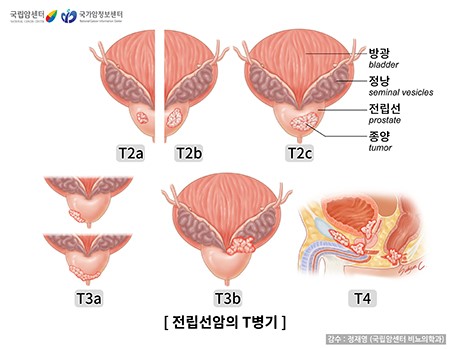
출처 : 국립암센터
Causes of Prostate Cancer
The exact cause of prostate cancer is still unknown. However, it is associated with factors such as advanced age, genetic predisposition, male hormones, and Western dietary habits. Other contributing factors include socioeconomic status and infectious diseases, but the most significant risk factor is age.
According to data from the Korea National Cancer Center, a total of 282,047 new cancer cases were reported in South Korea in 2022. Among these, there were 20,754 cases of prostate cancer, accounting for 7.4% of all cancer cases and ranking 6th overall. Among cancers affecting men, prostate cancer ranked 2nd.
Main Symptoms of Prostate Cancer
Unlike benign prostatic hyperplasia (BPH), prostate cancers usually are found in the peripheral zone of the prostate, away from the urethra. Therefore, in its early stages, it often does not cause any noticeable urinary symptoms. If the tumor grows large enough to affect urinary function, clinical symptoms may appear. By this stage, the cancer is often already significantly advanced.
[Urinary Symptoms and Others]
| Frequent urination (including nocturia) |
Needing to urinate more often than usual during the day and at night. | Incomplete emptying (residual urine sensation) |
Feeling like the bladder is not completely emptied after urinating. |
|---|---|---|---|
| Urgency (urge incontinence) |
A sudden, strong urge to urinate that is difficult to control. | Hematuria | Presence of blood in the urine. |
| Weight loss and fatigue | Unexplained weight loss, general weakness, and loss of appetite. | ||
[Symptoms of Metastasis]
| Bone pain (pelvic pain) |
Severe pain in the lower back or pelvic area. | Neurological issues | Compression of the spinal cord can cause neurological symptoms in the lower limbs. |
|---|